
Why Does Packaging Design Matter When Sourcing Dining Chairs from China?
Packaging design is a critical supplier evaluation metric when sourcing dining chairs from China because it directly dictates transit damage rates, furniture container loading efficiency, and total landed product margins. Professional packaging engineering safeguards upholstered seats, swivel mechanisms, and powder-coated metal frames across long maritime transit routes to Europe while maximizing container volume utilization, lowering per-unit freight rates, and supporting sustainable packaging standards with reduced plastic use.
Why is packaging design a core sourcing risk factor when importing dining chairs from China?
When European furniture wholesalers, retail chains, and purchasing groups import dining chairs from China, intercontinental ocean transit subjects cargo to substantial physical and environmental stresses. Long maritime voyages involve weeks of continuous vessel vibration, dynamic shifting, ambient temperature swings, and relative humidity changes. Without engineered transit protection, dining chairs arrive at European warehouses with scratched powder-coated frames, crushed upholstery, torn fabrics, broken swivel mechanisms, or deformed foam padding.
In professional B2B furniture procurement, transit damage generates operational costs that extend far beyond the unit price of a replacement chair:
- Return Logistics and Administration: Managing customer claims, return freight, secondary warehousing, product inspection, and disposal across target markets such as Germany, the Netherlands, the UK, Poland, Switzerland, and Ireland creates severe administrative overhead and margin erosion.
- Broken Sets and Fulfilment Delays: When an importer brings in coordinated dining sets comprising dining tables, dining benches, and dining chairs, damaged chair units prevent complete set deliveries, stalling order fulfilment and tying up working capital.
- Commercial Retail Disruption: Furniture retailers and contract furniture buyers depend on reliable stock arrivals. Elevated transit damage rates disrupt seasonal showroom promotions and online catalogue deliveries.
- Container Inefficiency and Freight Waste: Shipping loose, oversized, or unoptimized cartons means paying ocean freight rates to transport empty air, directly inflating landed costs per chair.
Professional dining chair packaging design China sourcing practices treat packaging not as an afterthought or a generic carton box, but as an integral element of product engineering and quality control. Experienced manufacturers like ASKT recognize that factory-floor quality is only effective if the furniture arrives in showroom condition at European distribution hubs.
How does knock-down (KD) engineering achieve dining chair carton optimization?
Knock-down (KD) structural engineering is the cornerstone of efficient dining chair packaging. Fully assembled dining chairs occupy an awkward footprint with significant void space between chair legs and around curved backrests. Sourcing fully assembled chairs drastically reduces container load counts, forcing buyers to absorb excessive per-unit shipping expenses.
Effective KD dining chair carton optimization requires integrating product development, metal frame fabrication, and packaging geometry. Designing modular components allows manufacturers to minimize external carton cubic volume while preserving the structural durability required for European residential and commercial use.
Systematic component nesting and carton organization
Optimized KD dining chair packaging achieves volume reduction through methodical internal layout planning:
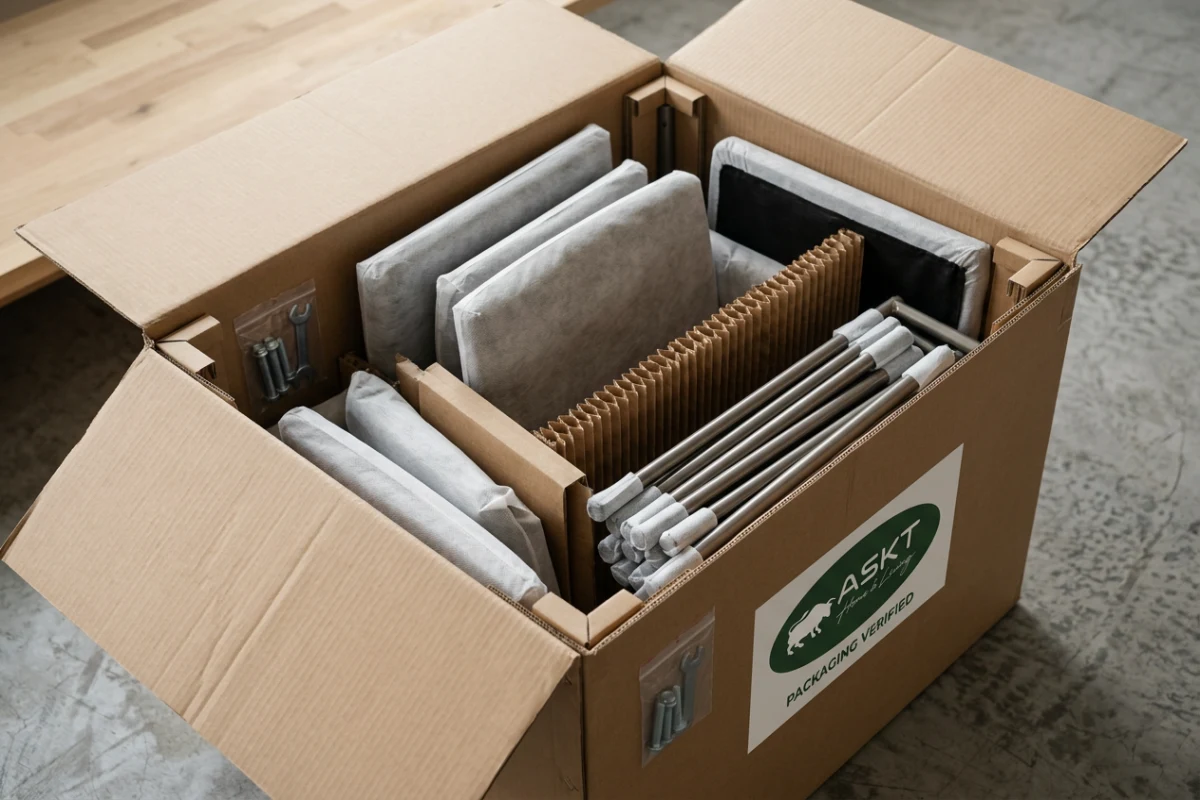
- Nested Seat Shells: Ergonomically shaped upholstered seat shells and pocket spring cushions are contoured to stack closely in pairs or multi-unit sets within a single outer carton without crushing internal padding.
- Disassembled Leg and Frame Geometry: Metal frame components, central swivel columns, and auto-return mechanisms detach cleanly and pack flat alongside or beneath seat shells.
- Secure Hardware Containment: Bolts, washers, and assembly tools are sealed in designated protective pouches and fixed securely inside internal carton voids, preventing loose metal hardware from puncturing fabric upholstery or scratching powder coating during transit.
- Consistent Part Tolerances: Precision manufacturing of metal frames, wooden components, and upholstery panels ensures that every production batch matches exact packaging dimensions, preventing carton bulging or uneven stacking.
By harmonizing structural engineering with carton layout, European buyers achieve lower landed costs, easier pallet handling, and reduced warehouse storage requirements.
How does packaging design directly affect furniture container loading efficiency?
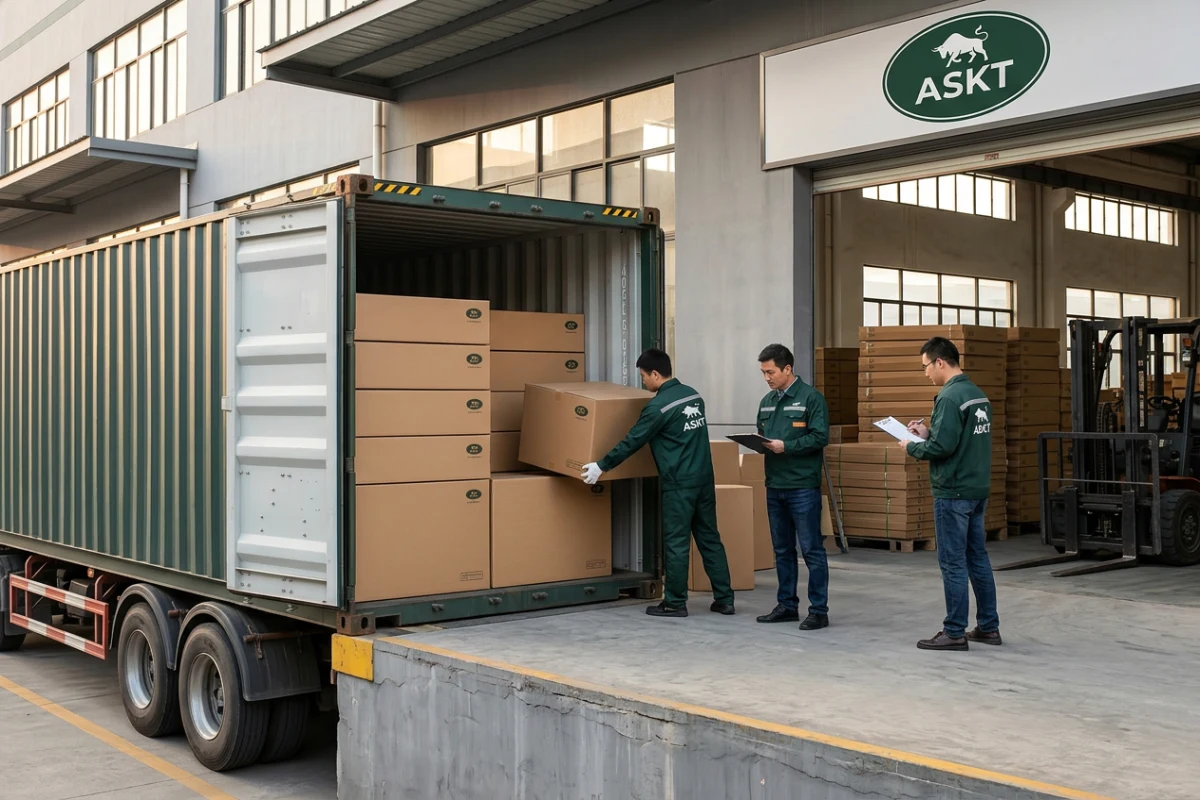
Container freight costs represent a major share of total landed procurement costs. Consequently, maximizing furniture container loading efficiency is one of the most effective strategies for European importers to protect their operating margins. Outer carton dimensions determine exactly how many units fit inside 20ft, 40ft, and 40ft High Cube (HQ) shipping containers.
A packaging dimensional variance of just a few centimetres in carton length, width, or height can disrupt container loading patterns, leaving unusable void spaces at the top or sides of the container. Professional Chinese manufacturing partners engineer outer carton sizes specifically to align with standard export container dimensions.
| Chair Structure and Packaging Format | Packaging Units per Carton | Relative Shipping Volume per Chair | 40ft HQ Container Capacity | Sourcing and Margin Impact |
|---|---|---|---|---|
| Fully Assembled Frame | 1 Chair per Carton | High Volume (Unoptimized) | Low Unit Count | High freight cost per unit; suitable only when assembly cannot be modified |
| Semi-KD (Detachable Legs) | 2 Chairs per Carton | Moderate Volume | Medium Unit Count | Balanced assembly time and improved container volume utilization |
| Fully Optimized KD / Modular System | 2 to 4 Chairs per Carton | Optimized Flat-Pack Volume | Maximum Unit Count | Lowest freight cost per unit; protects landed margins for high-volume wholesale |
| Stackable Contract Frame | 4 or more Chairs per Bundle/Box | Compact Nested Volume | High Unit Count | High logistics efficiency for commercial, hospitality, and contract projects |
When conducting supplier negotiations, European purchasing managers should evaluate total landed cost rather than focusing exclusively on the initial factory price. A supplier offering thorough KD dining chair carton optimization can deliver significantly more units per shipping container, resulting in a substantially lower landed cost per unit and superior commercial profitability.
What protective cushioning and sustainable packaging materials should European buyers specify?
Protecting upholstered dining furniture from impact, surface abrasion, and ambient moisture requires specialized protective materials tailored to diverse surfaces, including velvet, textured fabrics, waterproof and easy-clean fabrics, pet-friendly materials, oak veneer, sintered stone, and powder-coated metal.
Simultaneously, European buyers are subject to strict regional environmental standards and corporate ESG goals. Sourcing strategies must incorporate sustainable packaging solutions that prioritize reduced plastic use and recyclable paper-based materials without compromising physical transit protection.
Material specifications for transit protection and sustainability
- Reinforced Corrugated Master Cartons: Master cartons should use high-grade double-wall corrugated cardboard capable of withstanding heavy container stacking pressures and prolonged oceanic humidity.
- Sustainable Paper-Based Cushioning: Importers can replace expanded plastic foam blocks with high-density honeycomb paper boards, corrugated inserts, and molded pulp corner protectors to safeguard edges while complying with European sustainability initiatives.
- Breathable Surface Protection: High-performance upholstery fabrics and upholstered dining chairs require breathable non-woven fabric sleeves rather than sealed plastic bags to prevent moisture buildup during transit across changing climate zones.
- Individual Metal Component Wrapping: Powder-coated metal legs, extension mechanisms, and swivel bases must be wrapped individually in protective paper sheathing or protective sleeves to eliminate metal-on-metal rubbing and paint abrasion.
- Edge and Corner Protectors: Heavy-duty compressed paper corner guards reinforce outer carton corners, preventing strap crushing during palletizing and warehouse cross-docking.
Balancing transit protection with sustainable packaging helps European furniture brands meet regulatory demands, elevate unboxing presentation, and minimize packaging waste disposal costs for end consumers and contract clients.
Why are transit drop testing and pre-shipment quality control essential?
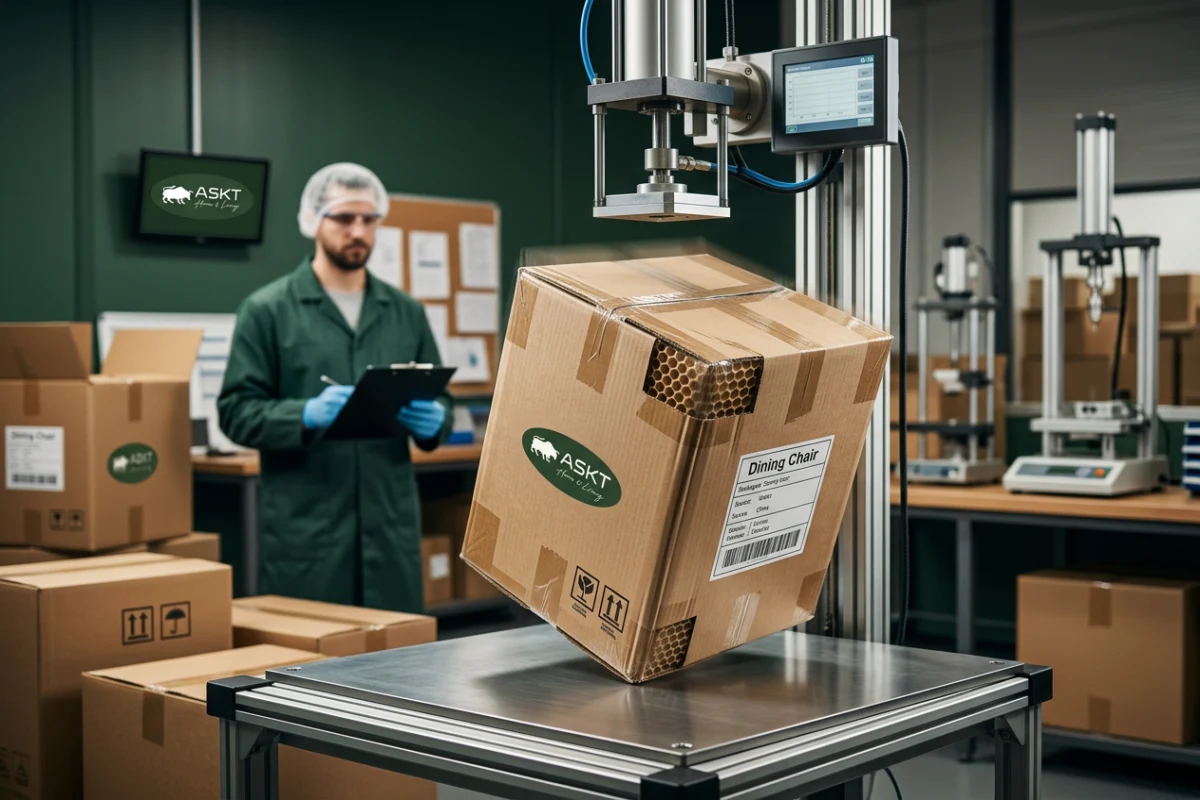
Theoretical packaging dimensions must always be verified through physical testing before mass manufacturing begins. Implementing dining furniture drop test transit protection protocols simulates real-world supply chain hazards, such as rough container loading, forklift vibration, pallet handling, and courier transit.
Core transit testing protocols and inspection checkpoints
A comprehensive transit simulation and pre-shipment quality inspection involves structured physical drop procedures on fully packed production cartons:
- Corner Drop Testing: Dropping the carton onto its most vulnerable corner to evaluate structural impact transfer to internal wooden frames, seat edges, and metal corners.
- Edge Drop Testing: Dropping the carton onto edges radiating from the tested corner to verify corrugated seam strength and tape adhesion.
- Flat Face Drops: Dropping the carton flat onto its top, bottom, and side faces to inspect internal cushioning compression, fabric rubbing, and hardware stability.
Following the drop test protocol, quality control inspectors open the packaging to check for specific failure criteria:
- Structural Integrity: Inspecting for cracked wooden seat shells, bent metal mounting brackets, compromised weld seams, or damaged auto-return swivel mechanisms.
- Surface and Cosmetic Inspection: Checking for scuffed fabric upholstery, chipped powder coating on metal legs, dented high-density foam, or scratched oak veneer and sintered stone surfaces.
- Internal Packaging Condition: Ensuring that internal paper dividers, honeycomb inserts, and hardware pouches remain intact and have not punctured internal or external carton walls.
Conducting transparent quality control and transit testing during sample development and mass production prevents costly surprises upon container arrival in European ports.
How should European buyers conduct a furniture packaging supplier evaluation in China?
Selecting a reliable manufacturing partner requires assessing their packaging design expertise alongside their furniture production capabilities. Sourcing teams should integrate explicit packaging criteria into their furniture packaging supplier evaluation checklist.
Key criteria for packaging supplier assessment
- Engineering and Customization Capability: Can the manufacturer engineer custom KD structures, optimize carton sizes for standard container volumes, and accommodate OEM and ODM requirements such as private-label branding, customized carton artwork, and multi-language assembly instructions?
- Material Quality and Sustainability Standards: Does the supplier use high-grade corrugated cartons, breathable non-woven protective sleeves, and sustainable packaging materials with reduced plastic use?
- In-House Testing and Verification: Does the factory have dedicated quality control procedures to execute pre-shipment drop testing, compression checks, and container loading simulations before releasing export shipments?
- Manufacturing Consistency and Tolerance Control: Does the supplier maintain disciplined quality management across metal frame fabrication, powder coating, foam density, and upholstery cutting to ensure consistent component dimensions across high-volume production batches?
- Export Experience in European Markets: Does the factory demonstrate a track record of exporting dining chairs, dining tables, bar chairs, and lounge chairs to markets like Germany, the Netherlands, the UK, Poland, Switzerland, and Ireland, with a deep understanding of European quality expectations?
Thoroughly evaluating a supplier's packaging design and quality management capabilities minimizes sourcing risk and builds a dependable, long-term supply chain foundation.